
To prevent nagging in-text references, do read my Ecological Arbitration and the Universal Mind for more context on the below. Consider this essay a sequel.
Setting the Scene
Stuck in a seemingly intrinsic morass of climatic-ecological despondency, those who care — or rather those who care to take notice, and then reach the natural and only conclusion to care — are searching desperately for a way out: a way out of an inescapable horizon precluding our imaginative, and thereby actual, capacities. Existing governance systems, whether economic, political, or legal, have failed to arrest, and in fact have undoubtedly directly caused, our calamity — and the acceleration thereof.
The evidence of this calamity is not worth repeating. One should not have to be informed for the nth time that we are entering and are in fact already inhabiting a period of unprecedented climatic-ecological instability; inhabiting a period of time wherein carbon is being released into the atmosphere up to two orders of magnitude faster than during the End-Permian extinction 252 million years ago; inhabiting a period of time wherein one species can at supposedly conscious will choose to — or not to — eliminate taxa en masse, and arbitrarily bring individual species back into being.1
Choosing not to use degrees of warming or percentages of land cover and biomass in evidencing our calamity is deliberate. Doing otherwise implicitly and unintentionally suggests that some level of warming and some level of biodiversity loss is acceptable. It is not and should never be about what level of morass is acceptable; it must instead be about what systems of governance lead to those levels being agreed upon in the first place — about distancing ourselves from the idea that tinkering managerial interventions presently suffice.
This framing is fortunately, in the second quarter of the twenty-first century, aged. Scholars, practitioners, and communities have for centuries cultivated systems of governance that seek to offer alternatives to the status quo. Legal and political alternatives, in particular, have proven alluring. Whether expressed by an ecological democracy that seeks to integrate non-human voices through systems of guardianship or representation, legal assignation of rights that seeks to guarantee specific bounded conditions of wellbeing for all ecological actors, or (comparatively) basic provisions of ecocide that punish individual human actors and organisations for outsize climatic-ecological harm, real-world applications are aplenty. This is particularly the case for the latter.
Environmental crimes, whether mismanagement of waste, pollution of waterways, or the murder of non-human actors, are readily criminalised the world over — the limiting factor for efficacy often being a lack of resourcing, poor enforcement, and corresponding corruption. Taking the assignations of rights as the assignations of legal protection more generally, species — in the UK by, say, the Wildlife and Countryside Act 1981, and in the US by the Endangered Species Act 1973 — are readily safeguarded too. But taking rights as they are, rights, and linking these with what or where rights almost universally stem from — representation — examples are few and far between. Totems of the rights of nature movement — which, eponymously, advocates for the granting of rights to natural non-human actors — include Ecuador’s constitutional enshrining of rights to existence, flourishing, and reparation to constituents of the natural world in 2008 and the granting of representational rights to the Whanganui River in New Zealand in 2017. Both cases involved — in fact relied upon and were driven by — indigenous communities’ epistemological framings that incorporate the natural world into their systems of governance and, linkedly, their decision-making.
Yet these were ultimately, and remain, human interventions. They involved and involve the physically arbitrary imposition of anthropocentric legal rights; integration into unecological organisational superstructures that arbitrate decision-making between human and now non-human actors. And they are thus entirely the consequence of human polities agreeing to grant and continuously re-grant rights of participation to non-human polities — although non-human actors would hardly conceive of themselves that way.2 For legal remedies to our morass, to the catastrophe we find ourselves in and have caused, to have any sense of efficacy, then, they must be simultaneously political, and preferably unboundedly democratic.
This binding — this duality — of the political and legal inherently relates to the pooling of sovereignty. Taking systems of (democratic) political governance as systems of aggregated sovereignty — as systems that pool individual actors’ sovereignties — the eco-democratic deficit of our present political conceptions and relations becomes clear. We inhabit, or rather have constructed and consciously maintain, a system of tyranny: an arbitrary superimposing system of planetary decision-making that systematically excludes all but one species from those decision-making processes — a system wherein sovereignty stems from one actor.3
Yet while that system’s maintenance is conscious, its construction may have been less so. Sovereignty, while denoting a belief in the legitimacy of a system of political — typically state-led — governance, similarly denotes how that legitimacy comes about: through a monopoly on violence.4 To hold legitimacy suggests the violent denial of other legitimacies — of other claims to legitimacy. To hold legitimacy equally suggests that individual violences — individual monopolies on violence held by human actors, whether enfranchised or not — sufficiently pool to enable an aggregate monopoly on violence.5
We now understand and for some time have understood the effects of humanity’s unilaterally ‘legitimate’ political systems. Those systems are of course hardly homogenous. While all are unilateral, and all exclusively wield an eco-Weberian monopoly on violence over those non-humans they do not integrate, the practice of that unilateralism and the level of violence wielded is not equal. Epistemologies and ontologies between the human communities that each monopolise violence differ — but it remains true that, fundamentally, all systems of legal-political governance made up by human actors alone, or by an analogous supermajority, embody an inescapable eco-democratic deficit that precludes an escape from the morass the biosphere is encapsulated by.
It is this fundamental truth which occupies scholars of the rights of nature and ecological governance aplenty. Many — as Craig Kauffman and Pamela Martin describe in their The Politics of Rights of Nature — view legal systems and their political underpinnings as Newtonian, or ‘Western’; they subsequently view some indigenous communities’ integration of the natural world into those Newtonian-Western-derived systems as ‘foreign’, as unnatural. It is, too, indigenous communities who themselves view these attempts this way — as attempts to, in the words of rights of nature scholar César Rodríguez-Garavito, translate ‘the more fundamental notion that everything is alive’ into Western legal traditions.6 Whether or not legal-political systems can encapsulate the — now in the words of Kauffman and Martin — ‘complex, nested, living ecosystems whose parts are all interconnected in ways that humans do not fully comprehend’, present legal-political arrangements are ‘based on a paradigm that is out of sync with the laws governing the natural world’. Alternative paradigms, though — including those that legally-politically integrate non-humanity — are hard to come by. Those that Kauffman and Martin discuss in Ecuador, Bolivia, Colombia, and India, including by assessing their pathways to implementation, success, and lack thereof, fundamentally rest within the out-of-sync paradigm. It is human monopolisation of violence through the rampant use of spatiotemporally compressing technologies — of these technologies’ unapologetic development and use to serve our species’ and only our species’ ends — that precludes legal-political systems that would spell a paradigm shift. Currently tested alternatives are in any case a mirage, a fiction resulting from humanity’s needs to arbitrate and decision-make its spatiotemporal dominance.
The alternative floated by Martha Nussbaum in her Justice for Animals forefronts the understandable absurdity of direct democratic-political integration of non-humanity. Democratic-political integration, to Nussbaum, does not entail the enfranchisement of non-human voices into our voting systems; it instead entails the radical enfranchisement of non-human voices into the decision-making that our voting systems inform. She, simply put, advocates for a non-human prerogative — a sudo command — that rejigs our source code’s operation in non-human interests. That operation, in her view, is one that doesn’t typically fit into rights of nature narratives: it focusses more on the ability of all individual beings to thrive, whether for the purposes of nature restoration and conservation or for the purposes of revolutionising our food systems. To her, it is less about the rights of nature or the rights of a specific species and more about the rights of individual beings — stemming from the recognition of their (sadly not obvious to some) ability to suffer and corresponding right to flourish. Regardless of the operation’s prescriptions, though, Nussbaum’s view is essentially one of proxy representation; one that is the result of belief and faith in a liberal tradition that seeks to minimise harm. It is, according to the Berggruen Institute’s Jonathan Blake, a simultaneous rejection of liberalism’s anthropocentrism and an embrace, or ‘product’, of the liberal tradition.
Sharon Krause, in her Eco-Emancipation, goes in a similar direction as Nussbaum first does. Political and thereby legal inclusion, to her, does not equate to ‘asking cows and rainforests to vote or run for office’, but instead reserving a ‘distinctive [considered] place’ into a new ‘regime of rights’ administered by human actors. This regime of rights is to, or rather would, emphasise nondomination — the nondomination of non-humanity by humanity. Krause is pragmatic about the form that nondomination would take, acknowledging that ‘to live … is inevitably to consume, transform, and destroy’. ‘Life’, Krause rightly points out, ‘entails violence’. Yet life does not have to entail a monopoly thereon and unilateral deployment thereof. Securing a ‘comfortable life’ for humankind should not and does not need to be synonymous with ecocide. It is instead ‘a necessary condition of existence, one that holds for all living things’. This brings me back to one of my central arguments in Ecological Arbitration and the Universal Mind: the fact that life entails violence does not mean that a linear path can be drawn between the kinds and extents of ecological violence carried out by human communities throughout history to the fanatical imposition of violence orders of magnitude greater imposed today. It also, neatly, raises a related point — one equally raised by Martin Luther King Jr. in his 1963 commentary on social emancipation while confined in a Birmingham (Alabama, of course) jail:
‘Lamentably, it is an historical fact that privileged groups seldom give up their privileges voluntarily. Individuals may see the moral light and voluntarily give up their unjust posture; but … we know through painful experience that freedom is never voluntarily given by the oppressor; it must be demanded by the oppressed.’
With this in mind, Karen Bakker offers a narrowed vision in her Gaia’s Web. Combining the strands of Krause and King Jr., she advocates for the en masse listening ‘to our nonhuman kin’ via a digital web of sensors approximating the needs and desires of that very non-human kin at any moment — whether through remote satellite imagery or specific, individualised, bodily monitoring. Not all listening is created equal, though. Bakker herself admits that what she puts forth is instead a kind of hearing — a listening that presumes neither good nor bad faith. Whether that hearing or listening results in corresponding action is separate to the kind of Gaia-encompassing digital web she proposes.
None of these proffered solutions, then, are able to address humanity’s historically contingent yet now undoubted and seemingly inviolable monopoly on violence. In fact, proffered solutions — both those discussed here and others — accept that monopoly as an unchanging physical fact, and attempt to build epistemological, organisational, or techno-delusional solutions therearound. Our inability to surrender or redistribute the violence we hold precludes the construction of a true ecological democracy.
Yet, as Krause rightly made clear in her Eco-Emancipation, a certain degree of violence is necessary — in fact natural.7 Reducing the extent of that violence by constructing systems and institutions which limit its reach or imposition in the first instance is thereby a worthy goal, and a valuable first step. And so the thought of integrating the voices of those we impose ourselves on follows, whether through political or juridical means.8
What proceeds is a historical analogy thereof; an attempt to, partly through narrative, illustrate the disarming nature of (representative) rights of nature and the ineffective route it embodies. As ever, I strawman, heavily. Rights of nature is a broad church, encompassing simple declarations of consideration of non-human interests at the local level to legislative and even constitutional efforts at national and international levels. There is, too, a big difference between juridical and political integration, yet I treat both (relatively) equally here. My aim in doing this is fairly simple: to fully break the notion — not that others have not made attempts to do so — that non-human interests can be adequately integrated into human decision-making systems; and that any attempts to do so without first reducing our monopoly on violence are worthwhile.9 That notion, in the legal-political world of the 1760s and 1770s Anglo-Atlantic, equates to the idea of virtual representation.10
Virtual Representation
It would be an understatement to say that the eastern seaboard of North America was in a time of flux in the second half of the eighteenth century. Beset by the equivalent of Great Power rivalries today — with the Iroquois Confederacy and western settler-colonial forces like France, Britain, and Spain each competing for land and resources — (geo)political stability was a fiction. In the mid-1760s, arguably the first truly global war — world war — had passed. The Seven Years’ War stretched across continents, with France, Britain, and each of their allied forces warring in Europe whilst simultaneously battling over colonies or to-be-colonies in the Americas, the Indian subcontinent, and Southeast Asia. This warring required, necessitated, the involvement of those living in each colony being fought over — whether settlers, the colonised, or, indeed, the enslaved.11
That involvement carried with it indebtedness, both identitarian and fiscal. The Seven Years’ War proved costly — half of the British Government’s budget was used up by interest payments on the newly bloated debt alone. In the Thirteen Colonies, recovery of these fiscal costs came in the form of taxation. Recovery of identitarian costs — or rather the repayment of loyalty — came in the form of the Proclamation Line of 1763, which delimited the boundaries of the Colonies and thereby guaranteed the territories of native allies in the war — the Iroquois and Cherokee in particular.12
While the Proclamation Line proved controversial for land prospectors in the Colonies — the Founding Fathers of the United States amongst them — it was taxation that drew real (or simply more) ire. Attempts to argue for and later enforce the Stamp Act, a Westminster-derived piece of legislation that essentially taxed official documentary exchanges to render them valid (through the eponymous use of a stamp), are an example thereof.13 The Act set off over a decade of disagreement and unrest, with it (in hindsight) acting as a key justificatory pillar for American independence. Taking taxation as a natural extension of violence — of the monopoly on violence and the ability for the holders of that monopoly to wantonly use it to exact tribute — it was those who were taxed’s lack of legal-political stake in the decision-making that authorised this violence that incurred ire.
Discussing the Stamp Act in 1765 (the year of its passing), Eton-educated Maryland resident Daniel Dulany put his opposition simply:
‘It is an essential principle of the English constitution, that the subject shall not be taxed without his consent, which hath not been introduced by any particular law, but necessarily results from the nature of that mixed government; for, without it, the order of democracy could not exist.’
And countering justifications for this lack of consent and lack of representation, Dulany wrote: ‘as the representation is not actual, it is virtual, … it doth not exist at all’. The idea of virtual representation, here, is that proffered by a number of members of Parliament to counter that which Dulany argued against. Virtual representation, in the words of its key proponent George Grenville — the Prime Minister between 1763 and 1765 and the key instigator of the Stamp Act — was the idea that:
‘The Parliament of Great Britain virtually represents the whole Kingdom … [with all colonies] subject to the dominion of the mother country, whether they are a colony of the freest or the most absolute government.’
It was the idea that those with essentially zero knowledge of those that they governed, separated by entire oceans and continents, could equitably and justly make decisions on their behalf.14 It was implicitly, too, the idea that what was good for the supposed mother country — for the violent monopolist — was good for its ‘children’. Fantastically attempting to cite examples of virtual representation, contemporaries like Grenville referenced West Country cider makers facing the equivalent of an alcohol duty — itself experiencing vociferous opposition and a repeal three years after its passing — and the East India Company, famously a bastion of representative democracy, being unable to vote. It is, as Dulany — considered a small-c conservative at the time — pointed out, ridiculous:
‘[T]his argument, which is all that their invention hath been able to supply, is totally defective; for, it consists of facts not true, and of conclusions inadmissible. … the notion of a virtual representation of the colonies must fail, which, in truth, is a mere cob web [sic], spread to catch the unwary, and entangle the weak.’
Many MPs agreed. Henry Conway, a General and member of the Privy Council, orated in the same year as Dulany and Grenville:
‘They can’t be serious, when they insist even on their being virtually Represented: Will any Man in this House get up and say, he is one of the Representatives of the Colonies, when, so far from being an Object of their Choice, the most sensible Man in the Colonies scarce knows such a Gentleman exists.’
Speaking in 1766, William Pitt, the Prime Minister from that year until 1768, went further. He called it ‘the most contemptible idea that ever entered into the head of a man’. To him, it did not ‘deserve serious refutation’. And while opposition to the impositions of the British Parliament was multi-faceted — and, it is worth noting, not necessarily widespread in its early days — the core disagreement rested on a now much-repeated and well-known dictum: ‘no taxation without representation’.15 Benjamin Franklin, acting as the emissary of the Colonies’ interests in the 1760s and 1770s, claimed that:
‘I know that whenever taxation has occurred in conversation where I have been present, it has appeared to be the opinion of every one that we could not be taxed by a Parliament wherein we were not represented … [and that a] tax is forced from the people without their consent if not laid by their own representatives.’
Maurice Moore, a colonial jurist, in 1765 concluded that the idea of virtual representation was ultimately reflective of ‘a defect in the Constitution of England’. This defect was that of inherent exclusion. And it remains so — the system that imposed tyranny on colonial subjects continues to impose tyranny on non-human subjects. The system that arbitrarily imposed violence to exact tribute from colonial subjects continues to arbitrarily impose violence to exact tribute from non-human subjects. The proposition that a Parliament full of detached elites could represent those whom they subject an ocean or continent away is outlandish; as is the proposition that any agglomeration of any people could represent and act for — or in the interests of — non-human beings. The claim of inherent ecological interconnection and interreliance between human and non-human beings, while true to some extent, is interrupted by the blatant, wanton, and far-from-inevitable violence that human beings exact on fellow non-humans — in fact, exact on each other.16 And the connected claim of potential guardianship, of being able to act on behalf of a species other than one’s own or an ecosystem as a whole, is little more than a ‘polite fiction’.17 The legal-political — constitutional — defect experienced then is one we experience now. Our eco-constitutional fabric is broken.
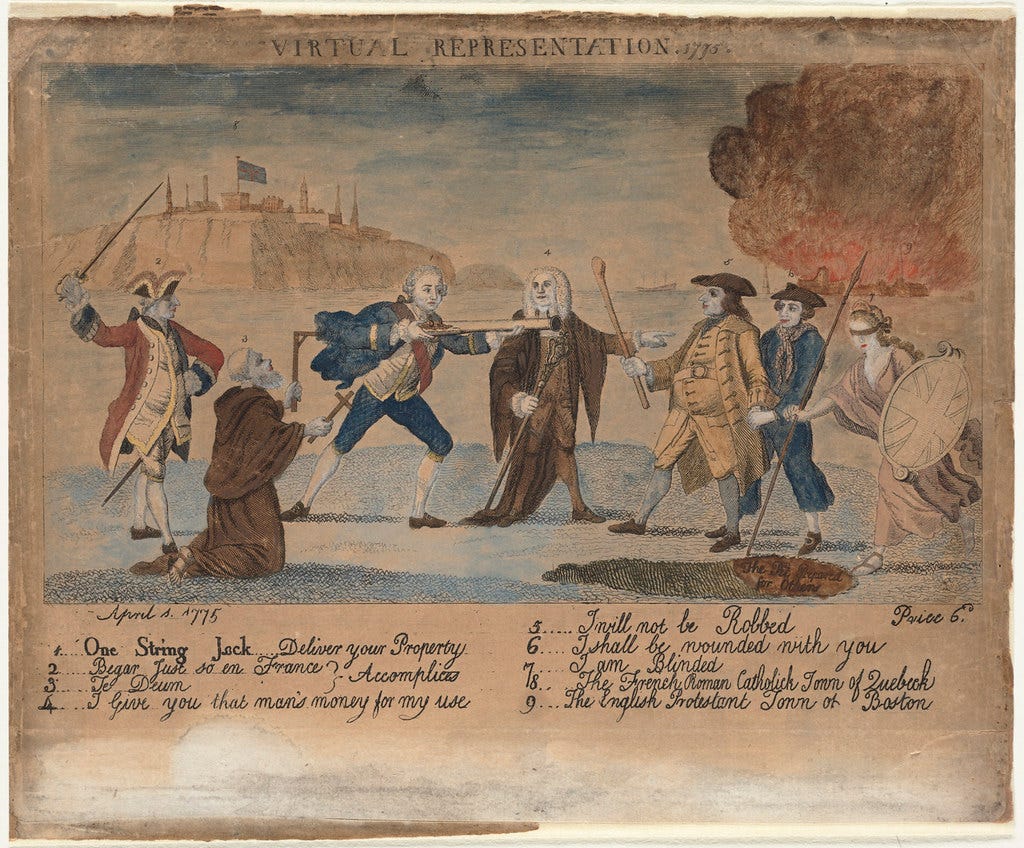
Virtual representation was never an intellectually coherent idea. Yet it was put forward for the simple reason that offering real representation — offering a real division in the monopoly on violence Parliament arbitrated through political means — would have by definition ended that very monopoly (or rather, fundamentally altered those which it was imposed on). It would have brought into Parliament voices that intrinsically disagreed with the Government’s positions; that would have eventually outnumbered Britain-representing MPs. And so in this way, we only ever argue for virtual representation when we argue for the integration of non-human voices into human decision-making systems; when we argue for the rights of nature. Real representation would entail the destruction of our own system — of our eco-colonial, extractive, expectations.
And there is a deep irony in the fact that even real representation for the Thirteen Colonies in the 1760s would have entailed anything but. It would have entailed an integration of landed, wealthy, white, male voices from one region of the world into a Parliament filled with landed, wealthy, white, male voices from its region of the world.18 This Parliament would have continued to make arbitrary, violent, decisions for those who were landless, far from wealthy, of any shade other than white, and women. While this is an imperfect analogy and while we are far from this reality today, our legal and political systems remain inequitable, dominated by a select few interests who (increasingly) wield disproportionate influence. Any form of real non-human representation would encounter irreal human representation at the first hurdle.
Natural Rights
James Otis was one of the most prolific and renowned critics of his contemporary status quo. His contempt for the idea of virtual representation and for that idea’s proponents is not worth citing — it is self-evident in one of the more radical ideals he put forth: that of natural rights. A renowned Harvard-educated lawyer, Otis drew from John Locke’s 1689 Second Treatise of Government to argue that British colonial subjects in the Thirteen Colonies — through their lack of representation in Parliament — were having their basic, fundamental, natural rights contravened upon.19 Those rights — ‘life, liberty, and property’ — which Locke posited individuals were ‘naturally endowed with’ arose through or were derived from the ‘state of nature’. Doubtless inspired by his experiences growing up in a slave-owning family, Otis in a 1764 pamphlet claimed that:
‘in state of nature [sic] no man can take my property from me without my consent: if he does, he deprives me of my liberty and makes me a slave. If such a proceeding is a breach of the law of nature, no law of society can make it just. The very act of taxing exercised over those who are not represented appears to me to be depriving them of one of their most essential rights as freemen, and if continued seems to be in effect an entire disfranchisement of every civil right.’
To Otis, ‘if a man is not his own assessor in person or by deputy, his liberty is gone or lays entirely at the mercy of others’. He may as well be describing the tyranny we impose on non-human subjects today. Otis, too, critiqued the very idea of parliamentary authority — particularly how it arises, how it is and can be (re)created, and how it can preside over those it does not accept the individual sovereignty of:
‘If on this memorable and very happy event the three kingdoms and the dominions fell back into a state of nature, it will be asked “Whether every man and woman were not then equal? If so, had not every one of them a natural and equitable right to be consulted in the choice of a new King or in the formation of a new original compact or government if any new form had been made? Might not the nation at that time have rightfully changed the monarchy into a republic or any form that might seem best? Could any change from a state of nature take place without universal consent, at least without the consent of the majority of the individuals?’
Universal consent. How can a system formed without universal consent continue to justifiably exist and continue to justly impose its decisions? Consent must be continuous. ‘Is it not a first principle of the original compact that all who are bound should bind themselves? Will not common sense without much learning or study dictate obvious answers to all the above questions?’20
Were Otis ecologically inclined, he could well today be arguing for a renewed compact that reflects the rights of all planetary constituents — he could well be arguing for the rights of nature, for the natural world’s inclusion in our literal or figurative parliaments. The current doctrine of governance, to him, could be — just as the doctrine of British parliamentary sovereignty was in the 1760s and 1770s — ‘a piece of metaphysical jargon and systematical nonsense’.
Yet a rejuvenated natur-ated doctrine would conflict with the folly that such a system of governance would entail: the folly of virtual representation; the folly that rights can be asserted without their corresponding and requisite enforcement through violence — or a monopoly thereon. The rights that Otis asserted were, literally, violently disregarded. Their assertion — or their collective assertion by Otis’s contemporaries — resulted in nearly a decade of war; two violences, the British and the “American”, competing for legitimacy, demonstrating (or at least attempting to demonstrate) their supposed monopoly.21 There is no competition today. The human monopoly on violence is absolute. This monopoly daily, hourly, second-ly contravenes upon the natural rights of all those who are not represented therein; who do not participate in our exclusionary, unilateral, system of legal-political-economic governance.
And this exclusionary system contravenes upon all beings’ natural rights, upon the state of nature it is based. The system’s — our — monopoly on violence is an aberration. It is not inherent to our existence. As Sharon Krause rightly argued, any kind of emancipatory framework would accept this. Our basic needs as defined by our extra-exploitative behaviour today are far from basic. And as I argued in Ecological Arbitration and the Universal Mind, the epistemological, organisational, and technological underpinnings of that behaviour did not have to end up the way they (for the moment) have. Otis expressed this differently:
‘Government is founded immediately on the necessities of human nature and ultimately on the will of God, the author of nature, who has not left it to men in general to choose whether they will be members of society or not, but at the hazard of their senses if not of their lives.’
In our case, it is the author of nature’s will — the natural world in itself, thereby nature’s will — that is unreflected in our system of governance. This system’s self-centred predilection for its only proponent is bizarre. An Otis of today would likely argue that government should be founded exclusively on the necessities of nature — its constituents being human or otherwise; where, the Otis of 1764 argued, the right to representation and inclusion in a system of overriding authority ‘seems to have placed them originally’. Locke’s conception of the state of nature was such that it guaranteed rights to (in practice, a select group of) humankind. A more accurate conception of the state of nature would consider the rights to domination we claim as incompatible therewith — as incentivising that state’s very destruction. It would, more than anything, consider that any supposed natural rights we claim would be matched by equal rights for other, non-human, actors.
Tying Things Together
I have thus far presented two strands. First, I contended that rights of nature as a solution to the morass we find ourselves in is a red herring. Whether implemented in a political or juridical form, and to whatever “extent” it may be implemented to, its base presumption of virtually representing and acting on behalf of non-human beings is ill-fated. Second, I contended that natural rights as conceived in the American revolutionary years should be recycled for the ecological revolution we so dearly need today. By doing this I essentially concurred with rights of nature scholars and practitioners, and revealed an inherent contradiction in my overall argument.
At the same time, the natural rights that James Otis vociferously propounded in the 1760s were only backed up by the violence the Colonies later mustered against the monopolist — the British coloniser. The monopoly on violence in today’s case, in our case, though, falls entirely in our hands. Our eco-colonial subjects are thereby left helpless.22
While many of my critiques against the concept of the rights of nature are contained in the prequel to this essay, it is worth raising two in full here. First, any implementation, whether political or legal, would not signal a departure from the status quo — it would simply rearrange the logic of a superimposing decision-making structure that arbitrates between different human, non-human, and non-sentient material actors that currently works towards only human ends. Its ability to consider other ends is hamstrung by the fact that those other ends are unable to assert their needs. Second, rights of nature is partly easy to advocate for because — at its fullest extent — it is an irreality. Any abstract concept has the potential to prove revolutionary, precisely because abstract concepts are abstract; irreal. The reason I present a line of argument against the rights of nature despite aligning myself with its advocates’ ideals is because I believe, in practice, that however currently implemented — whether in Spain, New Zealand, or Ecuador — or prospectively implemented it acts and will act as a justificatory consultative framework for our system of inherently human-dominated resource arbitration; a system underpinned by our inherent monopoly on violence. By consuming rhetorical oxygen, rights of nature discourse embodies an alluring, elusive, fiction.
Proponents would here point to the diversity of rights of nature discourse and practices — diversity that I explicitly put aside early in this essay. I will here acknowledge that diversity. Yes, rights of nature can take a constitutional pathway. Yes, it can take a legislatively guaranteed guardianship-aligned pathway. Yes, it can take a path of legal personhood for defined ecological entities. And yes, it can take the path of a local council voting protective provisions for its local river through; or simply hosting an Interspecies Council-type workshop. But the emergent properties a widespread and attemptively coherent implementation of rights of nature may embody are unknown. All that is known is that whatever decisions those altered systems may reach will continue to be dominated by human voices. Arguing at a small scale and arguing at a systemic, large, scale are two fundamentally different things.23 That is not to say that the status quo is any better. But the solutions the status quo offers — hard, direct, enforcement of environmental limits — are simple (and proven). And not deceptively so. The monopoly on violence we do hold can be used for good, and quickly.
But that counter-argument is well-trodden, and not necessarily one I wish to dissect here. I would like to instead acknowledge the limits of the historical analogy I made: the purpose of the comparison is to remove ourselves from present contexts. Arguing against what would today be deemed virtual representation would be brushed aside — legal-political rights of nature approaches are inherently virtually representative. Yet citing removed historical and historic argument on that representation’s validity is likelier to legitimise debate. Another limit is the admittedly false dichotomy I have set up. To be clear: it is not an either or. It is not an all-out cows-running-for-office, as Martha Nussbaum put it, or subjugatory human-imposed ecological totalitarianism. There is room for a middle path, but that path requires a practical and rhetorical temperance — an eco-realpolitik — that I have sought to justify the need for in this essay.
So I have backed myself into a rhetorical corner. I disagree with those I agree with and agree with those I disagree with. My critique lands entirely on our unwillingness to reckon with our inviolable monopoly on violence and its inextricable consequences on the human systems that we, humans, use to govern the world — the planet. So to conclude, I want to — within reason and without false hope — question this inviolability; to question this stubborn intransigence.
The unilateralism that I have claimed our monopoly on violence expresses is false. Yes, we can essentially eliminate any non-human being and the biome(s) they inhabit at will; as can we alter the biogeochemical makeup of the planet’s atmosphere and oceans. But that exhibits a unilateralism and monopoly present over only short time horizons. A monopoly on violence can only exist if those without monopolies do — if those that violence is both imposed on and fed by exist. Monopolists are not lonely elements inhabiting a vacuum. They remain interdependent, and if they kill all those they depend on they themselves will die. And while our interdependence may not substantively bare its teeth now or even in the next few decades, it is the meta-monopolist on violence — the aggregate planetary monopoly that we have disrupted — that will reign supreme in the end.
This meta-monopolist’s violence transcends any form we hold and can ourselves impose today. The energy the planet will-lessly, indiscriminately, and arbitrarily forces on its inhabitants exceeds by orders of magnitude the nuclear capacities we can wield. That energy is, by its non-sentient nature, patient too. Whether tectonic or climatic, it acts wantonly and without a remorseful(/less) guiding framework. It is in this sense secure — contrasting with the insecure, determinately indeterminate nature of our violence; that insecurity stemming from short-termist, narrow, and unknowledgeable inclinations that do little for our and others’ long-term wellbeing. The durability of our own monopoly is thereby fragile, subject to the exigencies of our internal deliberations.
Yet until our supremacy is demonstrably superseded by the meta-monopolist’s, the need to arbitrate our spatiotemporal dominance through the organisational structures we take as givens — whether legal, political, or economic — will predominate. And that need may well preclude the ecological revolution non-humanity requires yet cannot itself pursue. Monopolies on violence are never voluntarily ceded when that cession entails a collapse in the monopolist’s stature and wellbeing. A slight decline may be acceptable; but a collapse, perhaps not. A revolution, though, can be relative. It may not need to be borne from revolutionaries — it may instead be birthed by those the figurative revolutionaries oppose: the pre-counter-revolutionaries; namely, us. Through our own failure, we may well create the groundwork for an ecological revolution: for a spatiotemporal clearance of monopolies on violence that stands to rebalance the ecologies that make up the planet — that make up the Earth.
The End-Permian extinction, albeit lasting over two million years — about ten times longer than homo sapiens’ existence on Earth — resulted in 97% of lifeforms going extinct.
In Ecuador’s case, a re-granting recently took place by referendum. For some reading on this, see here. It would also be worth qualifying the separation I make here. Human superstructural impositions are hardly created equal: one cannot consider Kichwa ontological and epistemological framings as the same as or even similar to those of a local English council’s populace considering a rights of rivers motion. Yet my point here is about the systematisation of a belief system and that system’s subsequent imposition, rather than about what form each belief system takes in the first place.
Although sovereignty in this context is somewhat catachrestic. No individual being (like no nation-state today) is sovereign. All beings and the ecologies they inhabit are deeply interdependent, whether it seems that way to them or not. So a monopoly on violence does not exactly equate to sovereignty here — it is less sophisticated, nor absolute.
That is not to say that non-violent means of legitimacy do not matter to sovereignty — just that when push comes to shove, they matter less.
That is not to say that individual actors have equal individual monopolies on violence. The inequalities and inequities that our societies seem to be at present inextricably weaved with create deep mismatches in legal-political influence.
From the 2024 book More Than Human Rights: An Ecology of Law, Thought and Narrative for Earthly Flourishing, which Rodríguez-Garavito edited.
Defining natural is tricky. Is killing and eating an animal natural? Are abattoirs and factory farms natural? Is picking a wild berry natural? Are rows of polytunnels growing berries natural? Note the difference in scale. But in any case, top-down-ascribing patterns in this instance is foolish: human communities and their behaviours are inherently, deeply, diverse.
Or economic means, as I discussed in Ecological Arbitration and the Universal Mind. While not emphasised here, you can just as easily read the proceeding essay through that lens.
This depends. Any attempt to reduce harm, no matter the extent of predicted harm reduction, is a good thing. Yet excessive focus on harm reduction measures that will fail to substantially reduce harm is not — excessive and substantially here being key. Consuming rhetorical oxygen through the pursuit of dead ends (dead ends being propositions that are fundamentally incompatible with the nature of human organisational systems) is unproductive. More on this later in the essay.
It is worth noting explicitly how the narrative I set forth embodies that which rights of nature scholars almost universally reject — the idea that non-human beings can and should be directly, democratically, represented in human systems of political-juridical arbitration. I do this not because I believe that the literature in aggregate wishes for this kind of representation, but to point out that the “idea’s” logical successor — that of virtual representation — is flawed.
To be clear, I am only discussing the relationship between Britain and one set of its colonies. I am not passing judgement on the relative relationship(s) with other colonies.
That Line, though, was revised in the years thereafter through subsequent treaties. It proved as fickle as attempts to tax (a number of) the Thirteen Colonies — for the same reasons.
For those with some knowledge of this period, you will note that I did not mention the Sugar Act of 1764, primarily because it did not raise quite the same level of ire that the Stamp Act did. Part of this was due to a seemingly technical distinction between the right of Parliament to raise external (i.e. import/export duties) and internal taxes. The duties imposed by the Sugar Act, though, were skirted, hence the Stamp Act’s later passing and harder-to-dodge nature.
An analogue today is the virtual representation of children. Children cannot vote, yet those who can supposedly act in their interest when doing so — and have accordingly passed legislation which guarantees them particular rights. Do or should we have an equivalent relationship with non-human beings? I would argue that we can hardly vote in the long-term climatic interests of our children today, yet at the same time we do not vote to actively eradicate them and their standards of wellbeing in the present moment as we continually do with non-human beings. A parental relationship regardless assumes a degree of knowledge, understanding, and authority which we do not have, and would likewise embody a sort of eco-neo-colonial mindset — coopting the parental colonial mindset exhibited by British contemporaries of the 1760s and 1770s — of arbitrary subjugation.
In particular, the disagreement rested on the right of Parliament to impose ‘internal’ taxes. Refer to footnote 13 on this.
The idea that human and non-human interests sufficiently overlap so that acting in non-human interests means acting in human interests and vice versa is similarly ‘virtual’ — despite it, particularly in the long-run, ringing true in many instances.
This is how John Cannon referred to perceptions of the idea of virtual representation in his Parliamentary Reform, 1640-1832.
Despite the Colonies’ inherently oppressive, undemocratic, structure, the fact that more white men were landed made it relatively more enfranchised than — and thereby feared by landed (elected) elites in — Britain.
For the sake of brevity, I am deliberately not discussing Locke’s Treatise at length, nor its interrelation with Hobbes and the like — for another essay, perhaps.
Going further with Locke, how can a state be formed — how can a social contract be agreed upon — without that consent; how can it be formed without the consent of those who are unable to consent? It cannot. It is thereby illegitimate.
Quotes added given Americanism was hardly a coherent, cohesive, identity at the time.
It should go without saying that one of the obvious failures in the historical analogy used lies in the fact that “American” representation in British political structures was practically possible — the oceanic separation and obvious aforementioned conflict of interest aside. This is, as the authors cited earlier in the essay, not true for non-human actors.
And that is without touching on efficacy. The recently granted legal personhood of the Mar Menor, a lagoon in the southeast of Spain, has improved its nitrate and pollution-filled waters little. Neither did, though, the countless previous and ongoing designated protections it holds. And even in Ecuador, constitutional protections don’t necessarily suffice. A judge in 2013 (albeit questionably) ruled that a major open-pit mine in the country’s Pichincha Province could go ahead, deciding that the public (human) interest overrode the private (natural) interest.